MEASURED 14.5× faster · 13.3× leaner on the same task, same agent, same repo See the method
HOW IT WORKS

Better tools, durable memory, and governed multi-LLM workflows.

Three layers, plainly. Augment your agent with no key, orchestrate a governed SDLC on your own keys, and keep both on a shared platform that survives every session.

01 · AUGMENT · NO KEY

Better tools for your agent

Helixor Code runs as an MCP server. When your agent needs to find or understand code, it queries the structural Code Index — not grep — and reads and writes stateful TODOs. No key is required because your agent supplies the model.

02 · ORCHESTRATE · BYOK

Governed multi-LLM SDLC

For nontrivial or regulated work, Helixor Code drives a workflow from the catalog and routes each step to the right model on your key — Claude triages, a human approves, Codex implements, with audit evidence at every gate.

03 · THE SHARED PLATFORM

Persistent & permissioned

Indexes and TODO stacks live server-side, so they persist across sessions and machines and can be shared with permissions. Built on the Helixor engine — works with any LLM, or without one.

LAYER 01 — AUGMENT MODE

Query structure instead of grepping.

When an agent starts with grep or file search, it has to read dozens of candidate files into its context window, exhausting token limits and ballooning latency. Helixor parses source trees across 12 languages using Tree-sitter into a persistent graph of symbols, call chains, data flow, and architecture rules.

Targeted MCP Intelligence:

The agent calls code.search and gets exact definitions, usages, and weighted bonds in a compact ~150 token payload rather than thousands of tokens of file dumps.

Commit-Aware Freshness:

When files are modified in git, Helixor splices working diffs into the index. The agent knows before answering if a file has changed.

mcp protocol flow
// 1. Agent queries MCP server
agent › {"tool": "code.search", "query": "RefreshToken", "mode": "definition"}
// 2. Helixor responds with typed node & bonds
helixor › {
"matches": [{"file": "auth/session.ts", "line": 42, "symbol": "RefreshToken"}],
"usages": [{"file": "api/client.ts", "line": 104}],
"blast_radius": {"bonds": 2, "risk_score": 12},
"freshness": "clean"
}
Payload size: 169 tokens · 0 files opened
workflow execution graph
✓ 01. intake · ticket #402 parsed
✓ 02. triage · severity medium, risk score 24
✓ 03. plan · implementation_plan.md artifact generated
⏸ 04. human approval · waiting for team lead signoff
○ 05. implement · routes to Codex
○ 06. tests · unit + contract test suite
○ 07. review · code.quality.assess gate
○ 08. release notes · pull request description written
Pipeline: sdlc.safe_change_delivery.v1 · BYOK on your keys
LAYER 02 — GOVERNED SDLC

Multi-model pipelines with human approval gates.

Ad-hoc coding agent prompts can drift, hallucinate edge cases, or introduce subtle architectural flaws. Helixor Enterprise orchestrates change delivery through checkpointed, deterministic workflow graphs where each stage produces an auditable artifact.

  • ·Right Model Routing: Route fast triage models to analysis, high-reasoning models to implementation, and dedicated validators to test suites.
  • ·Resumable & Retryable: Every step is checkpointed with up to 3 automatic retries before pausing for human intervention.
  • ·BYOK: All model calls execute on your provider keys at your contracted volume discounts.
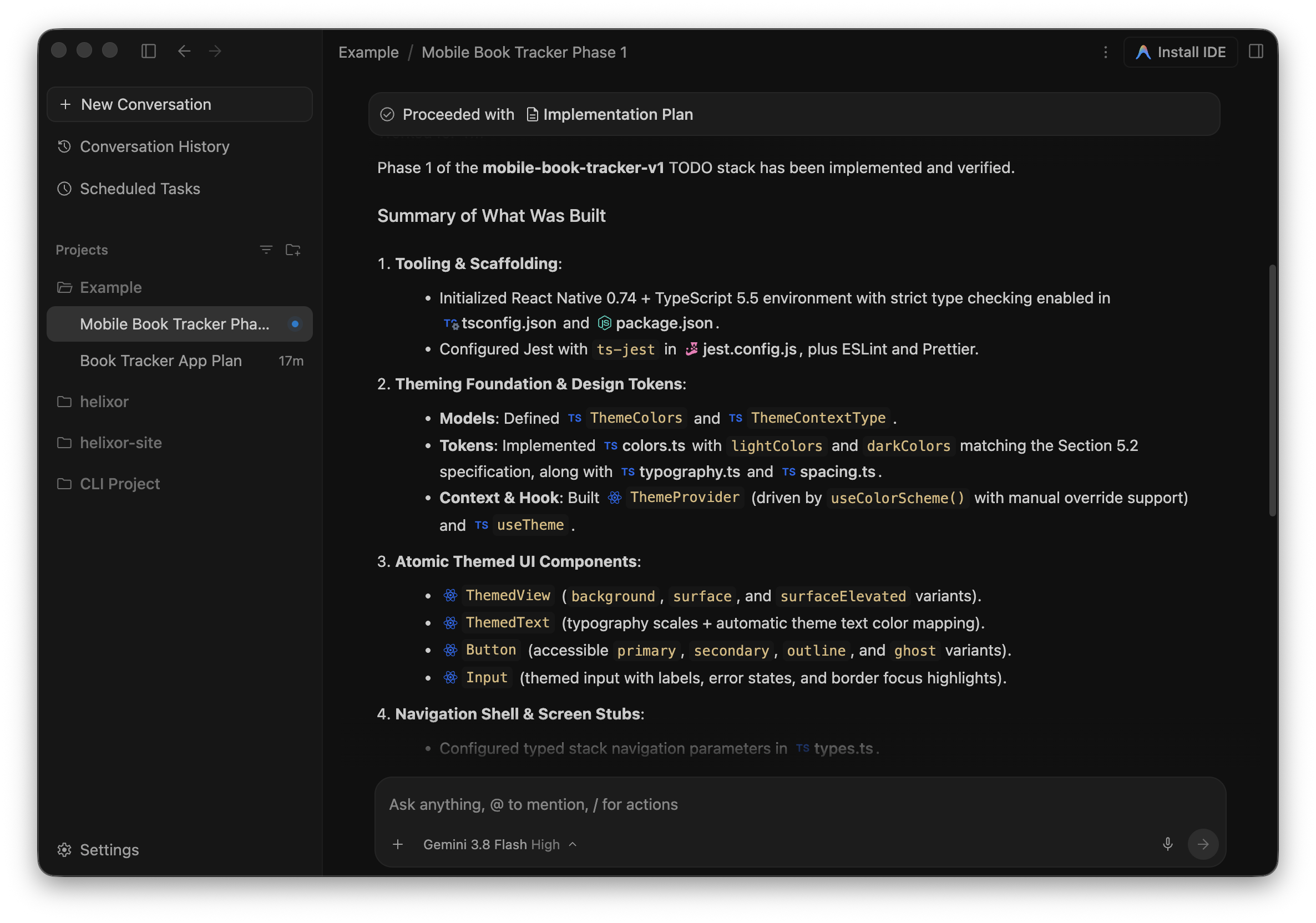
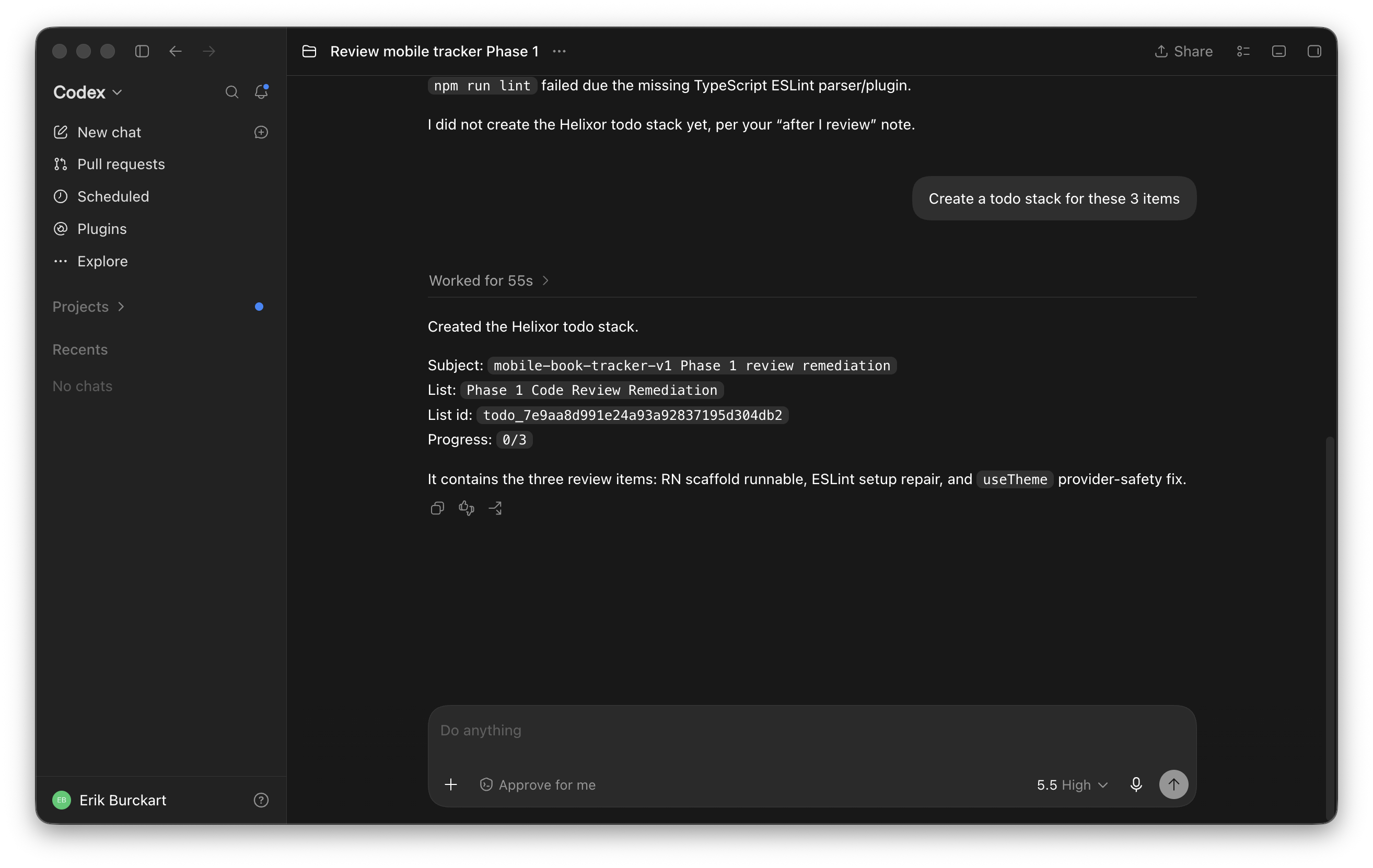
Stage 05 · Implement in Antigravity Phase 1 Scaffold
Antigravity implementing Phase 1 scaffolding
Stage 07 · Review & Remediate in Codex Audit Stack
Codex code review creating remediation TODO stack
LAYER 03 — SHARED PLATFORM

Persistent engineering memory, zero code exposure.

Enterprise security requires that proprietary source code never leaves the developer's authorized workstation. Helixor Code decouples the code index from team memory using a hub-and-spoke architecture.

01 · Spoke (Local)

Source code & Index

Repositories are parsed and indexed locally using native binaries. The structural database resides on the developer's disk (e.g. .helixor/), never transmitted over the wire.

02 · Hub (Shared)

Memory & Identity

Durable TODO stacks, workspace channels, architectural decisions, and server-derived identity are synced through a lightweight hub that deploys in 5 minutes and scales to zero.

03 · Security Boundary

Fails Closed

Clients cannot forge author identity. Inbound ports and VPNs are not required. Complete airgap and LAN-only operation are fully supported for defense and regulated environments.

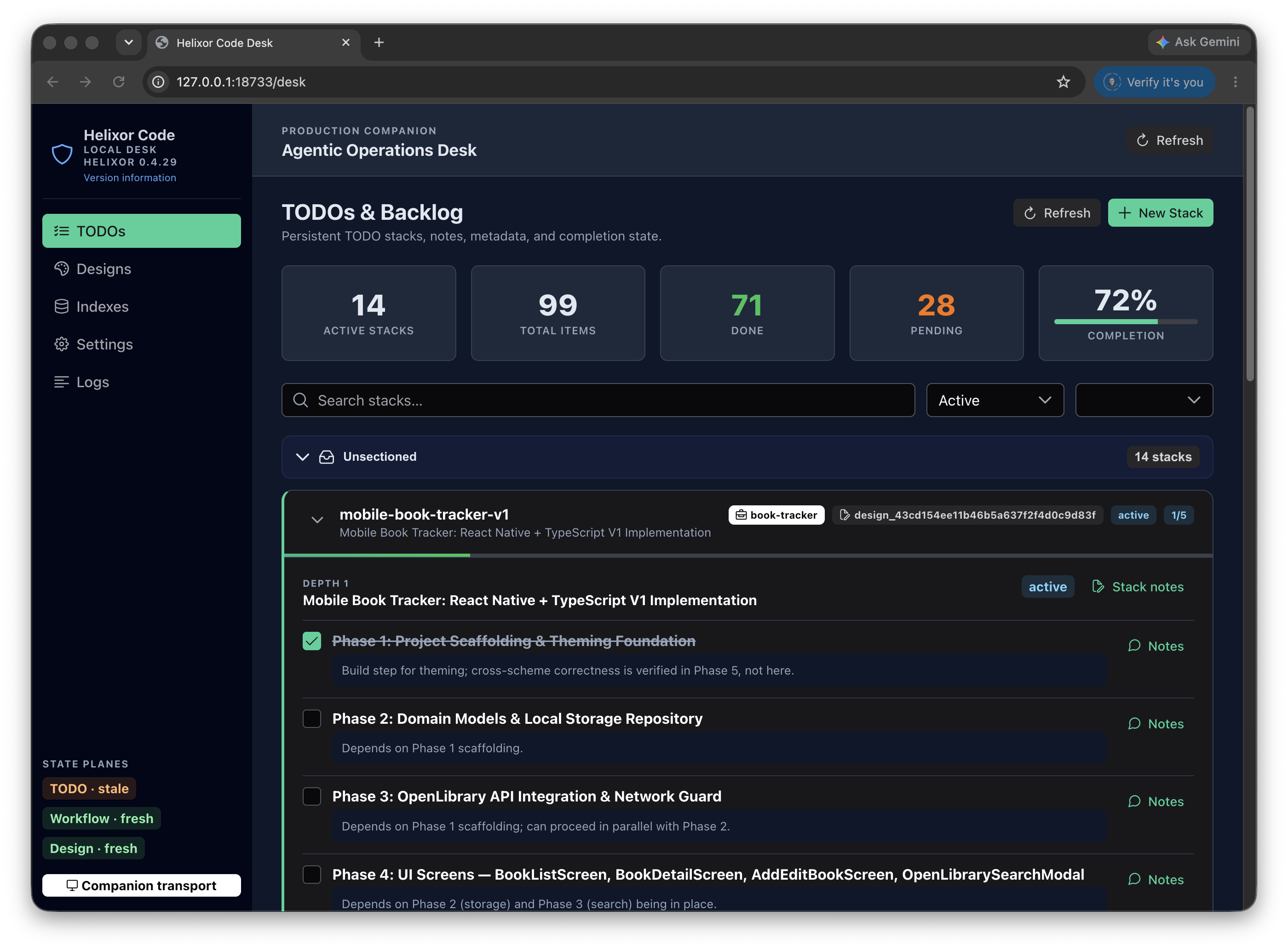
Spoke Work Surface · 127.0.0.1:18733/desk (Local Desk) ZERO CODE EXPOSURE
Local Desk interface: the developer's window into local spoke indexing and synchronized hub state

Ready to test it on your codebase?

Follow the 4-step onboarding guide. Takes about five minutes with zero keys required.

Get started now Browse documentation