MEASURED 14.5× faster · 13.3× leaner on the same task, same agent, same repo See the method
THE PRODUCT · LIVING CODE GRAPH

Everything the agent was missing.

Three layers sit behind one MCP connection: a structural index of your repository, a durable memory of what your team decided, and — for enterprises — a governed pipeline that routes the right model to each step of delivery.

01 · Code index 02 · Memory layer 03 · Architecture 04 · Benchmarks 05 · Governed delivery
Start free See how it works
2A LIVING CODE INDEX · DOUBLE HELIX
AST GRAPH
{ ; [ } parseRequest() class Session import auth refreshToken() if user.active await fetch(...) for (const f of files)
01 · THE LIVING CODE INDEX

Not grep. Not vector RAG.

Tree-sitter parses 12 languages into a typed graph, then Helixor compiles structure on top of it. The agent asks a question and receives typed answers — definitions, usages, bonds — instead of a stack of files to re-read.

Definitions & usages

Every symbol, where it lives, and everywhere it is touched.

Control & data flow

How execution and values actually move through the repo.

Weighted bonds

Coupling strength between symbols, so blast radius is rankable.

Motifs & rules

Positive and negative patterns scored against your architecture rules.

Commit-aware freshness

Git diffs are spliced into the index as they land, so the agent knows its knowledge is stale before it answers instead of confidently guessing.

Living Code Index
COMPILED
$ helixor index ./ --full
indexed my_project locally: 38 files, 693 nodes, 251 edges
local artifact: ~/my_code/my_project
codebasemy_project
graph density693 nodes / 251 edges
languages parsed12 supported
freshnessclean (git diff spliced on edit)
quality score97 / 100 (Grade A)
motifs & rules3 findings (0 critical · 3 low)
artifact lives on this machine · zero source code uploaded
02 · PERSISTENT ENGINEERING MEMORY

The half nobody else ships: memory that outlives the session.

Durable, depth-aware TODO stacks and workspace channels over MCP that survive sessions, machines and IDEs. Claude and Codex post into the same channel, pin decisions and hand work off to each other — auditably, under each developer's real identity.

Identity is server-derived and fails closed: a client cannot claim to be another author. Every usage stat is a measured counterfactual with its method printed — tokens served vs. avoided, file reads avoided, stale-index catches. No invented "productivity" numbers.

codex · helixor mcp
todo ▸ stack "payments-refactor" · 4 deep · shared
1. split settlement writer done
2. backfill idempotency keys in progress
3. retire legacy webhook path
channel ▸ claude pinned "idempotency key = order_id + attempt"
handoff → codex · author verified server-side
Session start

"What's stale in this repo?" · "What is Bob working on?"

During work

"Explain this flow." · "What violates our architecture?"

Session end

"Update my stack and post a 3-line summary to the team channel."

Friday

"What has Helixor done for us this week?"

PROVEN IN PRODUCTION

From Agent Action to Live Desk Visibility

When an agent writes to a TODO stack or design record via MCP, the change is immediately synchronized and visible in the companion's Local Desk — persistent, depth-tracked, and ready for handoff.
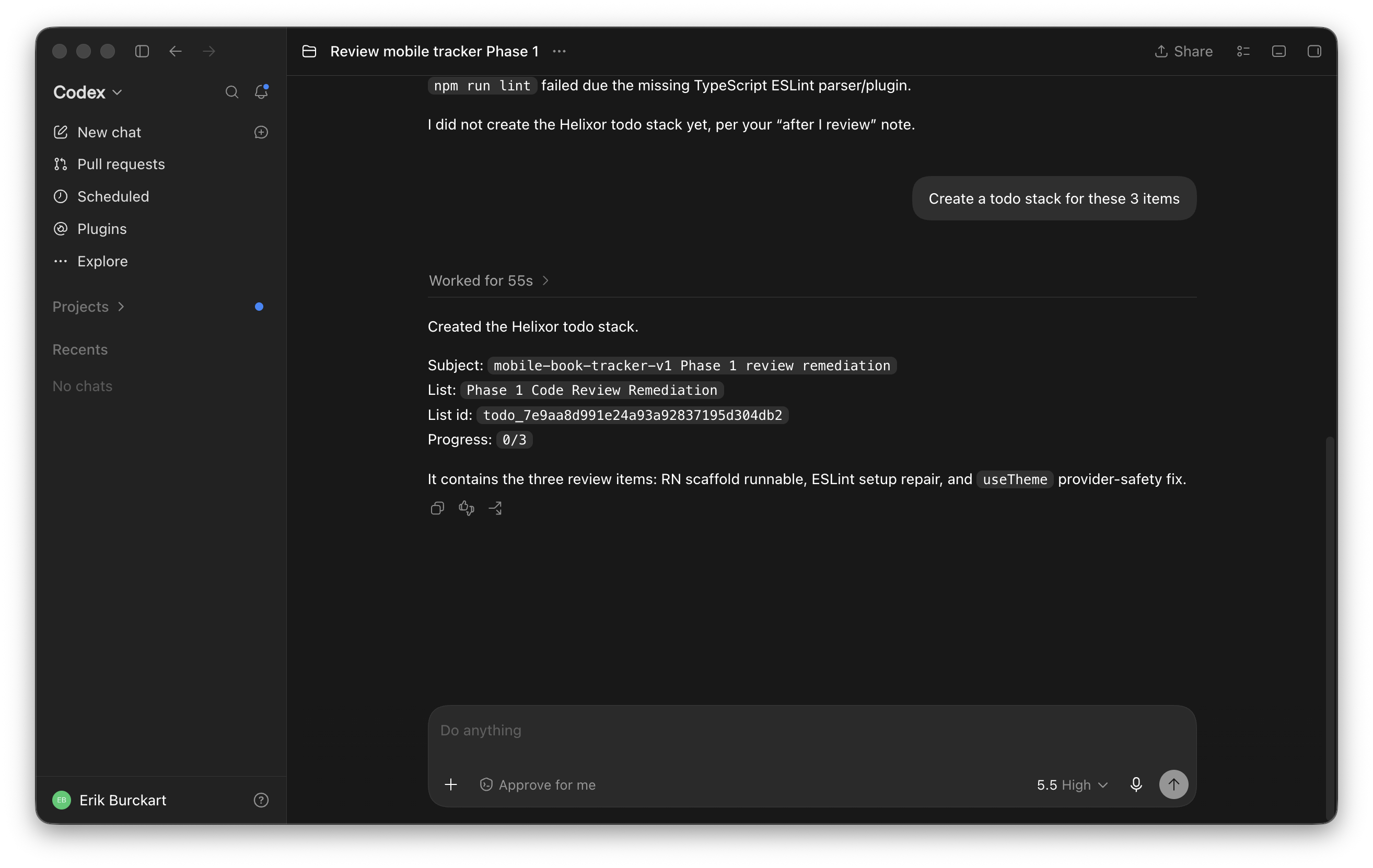
1. Agent Stack Creation · Codex brain.todo push
Codex creating a durable Helixor TODO stack from code review findings
Codex converts code review remediations into a 3-item durable stack (todo_7e9aa...) linked to the design spec.
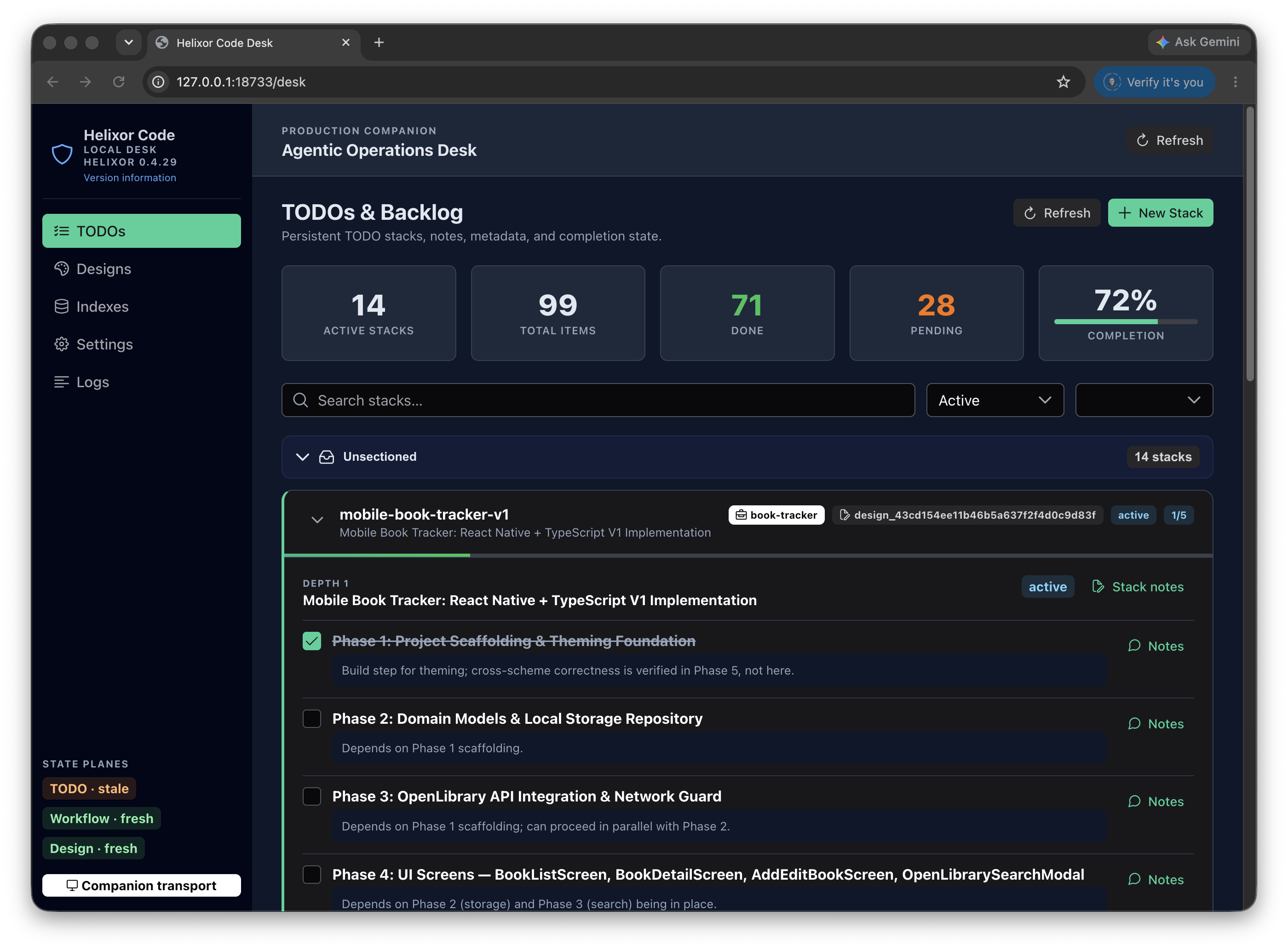
2. Real-Time Operations Desk · 127.0.0.1:18733/desk STATE PLANES
Helixor Local Desk displaying active stacks, phase status, and state planes
The Local Desk tracks completion across 14 stacks, showing phase status, linked designs, and authority planes in real time.
03 · ARCHITECTURE

Code stays local. Memory is what's shared.

Hub and spoke. Each developer's machine indexes its own repositories, and the source and the index never leave it. What the hub carries is the engineering memory — designs and TODO stacks, channels and identity — hosted as SaaS or on your own Enterprise servers. No VPN, no port forwarding. The hub deploys once in about five minutes and scales to zero; each developer onboards in about five.

Local — the spoke
  • Source code
  • The structural index
  • Parsing, scoring, rule checks
  • Local git freshness
Shared — the hub
  • Designs and pinned decisions
  • TODO stacks and channels
  • Identity and attribution
  • SaaS or Enterprise servers
Hub deploy ~5 min, scales to zero
Developer onboard ~5 min
Networking No VPN, no port forwarding
Hub hosting Helixor SaaS or your servers
HUB · SHARED CONTEXT DESIGNS · TODOS · CHANNELS · IDENTITY SAAS OR ENTERPRISE SERVERS DEV · INDEX CODE STAYS LOCAL DEV · INDEX CODE STAYS LOCAL DEV · INDEX CODE STAYS LOCAL
04 · MEASURED, NOT CLAIMED

Same task, same agent, same repo.

One real question
Without Helixor
With Helixor Code
Agent time
3:17
0:13
Tokens into the model
98.6k
7.4k
Tool rounds
10
6
14.5× faster · 13.3× leaner
3.9×

Faster index build at repo scale — 19.5s vs 75.6s.

8.8×

Smaller query payload — 169 vs 1,492 tokens.

25,000×

Leaner than raw context, budget-bounded.

A naive graph artifact can end up larger than the source it indexes — 25.5M tokens on a 10.16M-token repository. Helixor answers are demand-proportional and capped by a token budget, so cost does not grow with the question.

05 · ENTERPRISE · GOVERNED DELIVERY

One pipeline, the right model for each step.

Checkpointed, resumable, and artifact-backed at every step. This is what "AI that enforces your engineering standards" actually looks like. Each model call runs on your key, at your rates.

Talk to us about orchestration →
intake triage plan human approval implement tests review release notes

sdlc.safe_change_delivery.v1 — every step checkpointed, retryable (3×), resumable, and producing a required artifact.

SDLC IN ACTION

Implementing a Multi-Agent SDLC

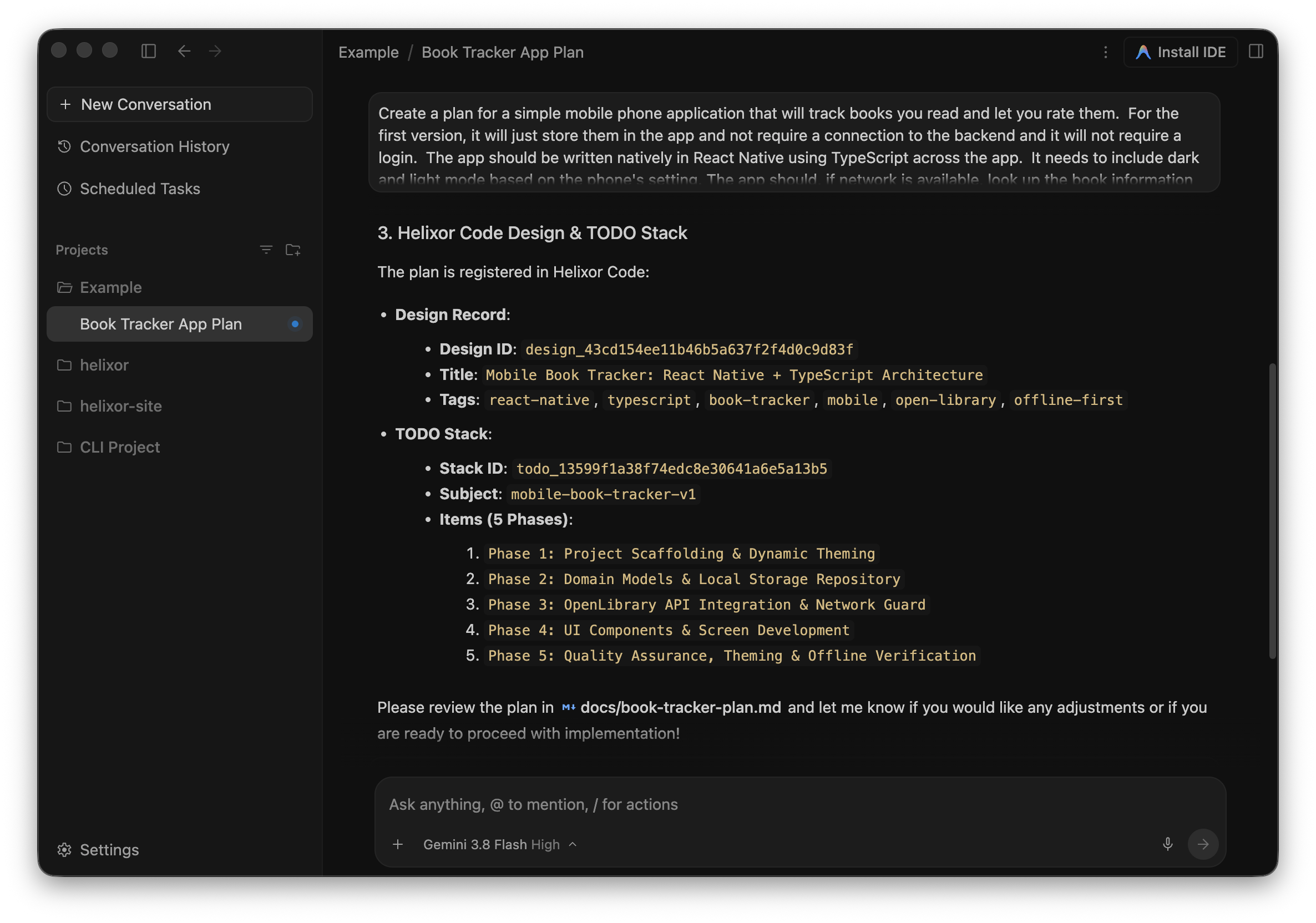
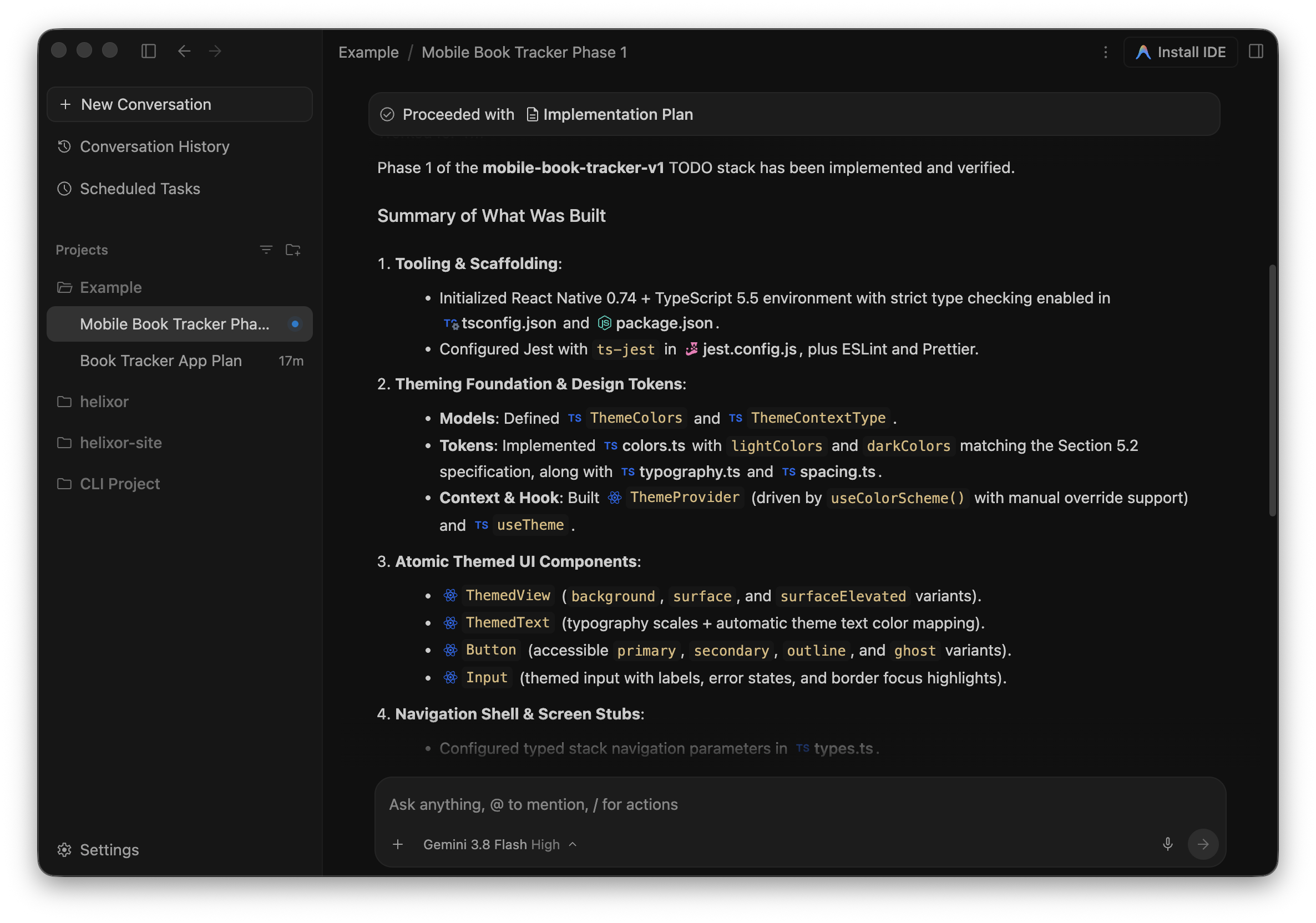
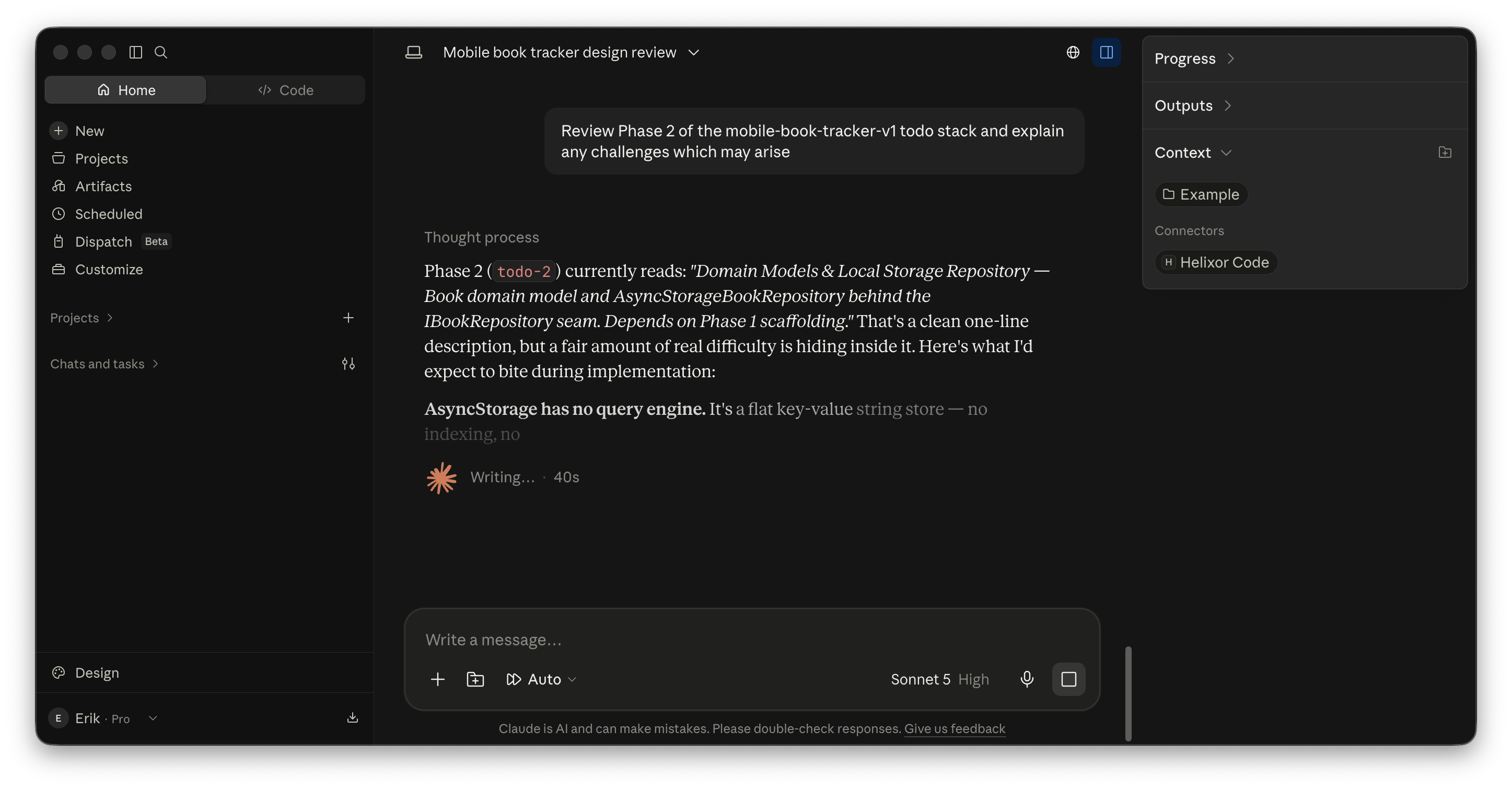
You can implement a multi-agent SDLC across your workflow. While each stage here was prompted manually by the developer rather than run autonomously, shared Helixor state kept the exact same project (mobile-book-tracker-v1) consistent across Antigravity, Claude, and Codex.

01. Plan · Antigravity design_...
Antigravity creating design and TODO stack
Creates design record and 5-phase work breakdown.
02. Implement · Antigravity Phase 1 Done
Antigravity implementing Phase 1 scaffolding
Executes scaffolding and verifies components.
03. Code Review · Codex Remediation
Codex auditing code and pushing remediation stack
Audits architecture and pushes review items to stack.
04. Verify · Claude Risk Analysis
Claude reviewing Phase 2 and identifying risks
Analyzes storage edge cases before Phase 2 execution.
WHERE IT RUNS

In the tools your team already opens.

VSCode / Cursor JetBrains CLI Web admin MCP-native Any LLM, any agent 12 languages Tenant-isolated Airgap / LAN mode
Start free Read the docs See pricing